
Description
Why Choose Husteon Nasal?
Temporary yet Rigid Support: With a thickness of 1.0 mm, the strip provides sufficient rigidity to straighten the nasal septum or augment the nasal dorsum, preventing post-surgical collapse.
Bioabsorbable: Does not leave a permanent foreign body; the material degrades over time (typically 18-24 months), facilitating natural tissue ingrowth and regeneration.
Biologically Safe (Synthetic): Being a synthetic polymer, it eliminates the risks of disease transmission or viral infection associated with biological or cadaveric grafts.
Customizable: Surgeons can easily cut and shape the strip within the operating room to fit the precise anatomical needs of the patient.
Key Specifications
Product Name: Husteon Nasal.
Dimensions: 40 x 10 x 1.0 mm (Rectangular Strip).
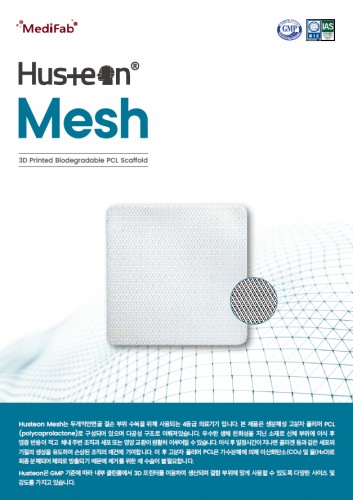
Material: Synthetic Polymer (likely PCL – Polycaprolactone).
Structure: Porous (to allow tissue and micro-vessel ingrowth).
Properties: Bioabsorbable, Biocompatible.
Usage: Surgical Implant.
Indications
Rhinoplasty: For dorsal augmentation or tip definition.
Septoplasty: As an internal splint to straighten severe deviations (Septal Extension Graft).
Nasal Valve Repair: To support the internal/external valves and improve breathing.
Reconstructive Cases: Post-trauma or congenital deformities where natural cartilage is weak or insufficient.
How to use
Prep: Prepare the surgical site. The mesh can be soaked in an antibiotic solution if required by the surgeon’s protocol.
Shape: Cut the Husteon Nasal strip using surgical scissors to achieve the desired shape and size (e.g., as a Spreader graft or Columellar strut).
Fixation: Implant the scaffold at the target site (over cartilage or bone) and suture it in place to ensure stability.
Closure: Close the incision. The scaffold immediately provides mechanical support while natural tissue begins to grow through its pores.